 This summer, instructors can take a variety of classes from Dutchess BOCES Educational Resources, including six related to artificial intelligence.
The classes, “AI in the Classroom: From Curiosity to Confident Practice,” “Google Tools & Gemini AI Workshop,” “AI for Planning, Feedback, and Differentiation,” “Gemini Inside Google Classroom: What Teachers Can Do Right Now,” “Building AI Literacy for Students,” a book study, “AI for Educators” by Matt Miller, are part of the division’s summer catalog, which offers classes on a wide variety of professional development topics.
AI is a hot topic in education. This spring, BOCES first AI conference, Leading Learning in an Intelligent World, drew about 60 educators and administrators from Dutchess BOCES and its component districts.
Educational Resources Professional Development Specialist Cara Braun noted that the conference was planned in response to requests from district assistant superintendents who identified a need for dedicated time to explore how AI impacts teaching, learning and leadership. Nearly 20 different sessions focused on balancing big-picture thinking and practical strategies that attendees can bring back to their districts. Many of the presenters were from Dutchess County school districts.
“Educators and leaders should feel empowered to explore these tools thoughtfully, focusing on enhancing instruction, supporting students, and making informed, ethical decisions about their use,” Braun said. “AI is not just a future concept – it is already shaping education.”
Below are highlights from the spring conference.
Morning Keynote
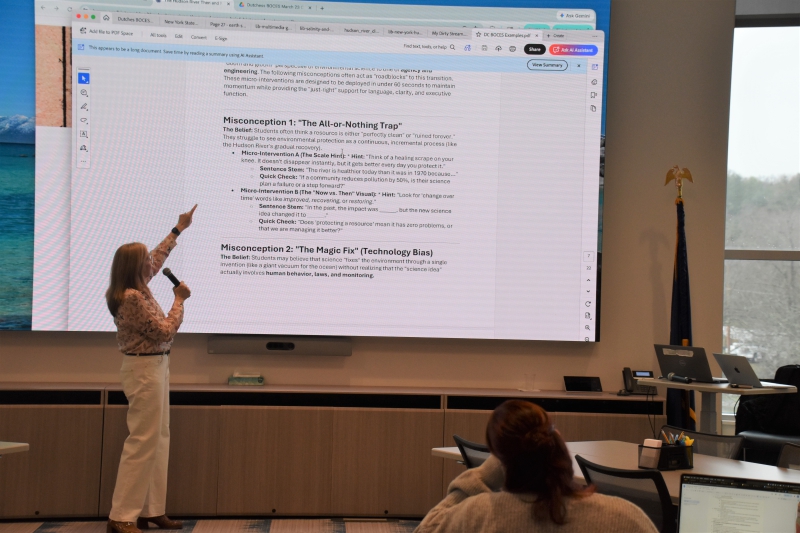 Dr. Andrea Tejedor, a Strategic Partnership Consultant for the New York State Association for Computers and Technologies in Education, shared how educators can use generative AI while staying grounded in what they know about their students. She noted that while AI is intelligent about the information it is fed, it lacks wisdom, a uniquely human trait.
“Start with data, but stay human,” Tejedor said. “The quantitative data that I see in informative assessment reports tells one story, but who I know as my students in a more conversational way, that’s very different.”
As many schools use Google technology, Tejedor showed how its AI assistant Gemini can be used to generate prompts and questions for assignments. She encouraged teachers to share Gems, or customized versions of the chatbot for specific tasks, with their colleagues. This enables colleagues to collaborate and contribute, refining the Gem to suit each user’s needs.
“If I share it with everybody, it now becomes something that is going to grow … so that it is becoming a more intelligent resource for all of us,” Tejedor said.
Afternoon Keynote
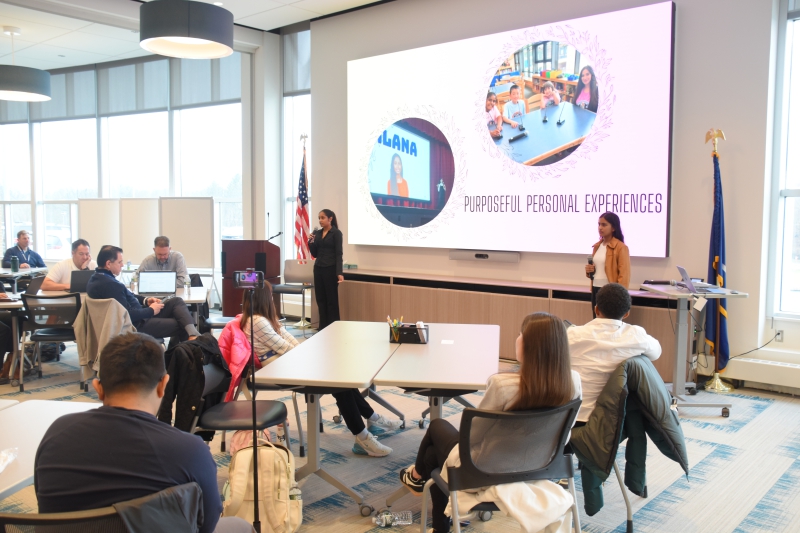 Pocantico Hills Central School District Educational Technology Director Alana Winnick brought four stellar students to share their perspectives on how AI helps them in the classroom. Winnick, adviser of the district’s Innovation Club, noted that AI can automate administrative tasks for teachers, but education will not innovate simply because it is automated. She advised AI users to look out for misinformation when using it and “remixing” AI-generated content with their own thoughts and ideas.
Sixth grader Riley referenced Albert Einstein in her presentation, as he valued the process of finding a solution over the final product. She noted that people use AI to get quick solutions where very little human thinking is involved, and students who think beyond grades have limitless potential.
“Think about this idea, what if there were no product? Imagine the learning you could do and the skills you could develop,” Riley said. “What we need more of is something called ‘human intelligence’ – hands-on work, creative thinking, something AI can’t give you.”
Winnick and the students later answered questions surrounding AI, including whether they ever get frustrated with it. Fifth grader Duane recalled using ChatGPT to get feedback on a poem he wrote and was consistently told to write more conventionally. He shared this with Winnick, who reminded him that AI is not flawless, and now he favors Perplexity AI for its more constructive feedback.
“It was created by humans, and not all humans are perfect either,” Duane said of AI.
Capitalizing on AI with Intention
This interactive session, hosted by Hudson Valley Writing Project Teacher Consultant Samantha Mossman, taught attendees how to use SchoolAI to garner helpful feedback by writing a story, uploading it to a SchoolAI Sidekick, and asking it for specific feedback on grammar and areas that need clarity. She encouraged attendees to get the most out of it. “Have some fun corresponding with it, ask it questions, push back if you don’t like your feedback,” Mossman said.
Attendees shared how SchoolAI offered feedback on improving their stories, while not giving them specific details, therefore encouraging them to think deeper about it. Mossman noted how she programs the chatbot to resist answering silly questions her students ask it or rewriting their work for them, all in an encouraging tone. “It does give you a lot of control as the person who created the chatbot to make sure that your kids are using it in a way that’s appropriate,” Mossman said.
Rhinebeck Central School District Assistant Superintendent for Curriculum & Instruction Katie Andersen was excited and curious to learn about how AI can enhance learning, while also keeping the human element involved. “Thinking about how to really give students feedback on their writing, but in a way that engages and makes them metacognitive about the process and what the parameters are around the chatbots, I found to be very helpful,” Andersen said.
Using AI Tools for Teachers of ELLs
Arlington Central School District ENL Coordinator Eliza Kondzielaski provided an overview of tasks that Gemini, Brisk Teaching and Diffit can help with, not just for teachers of English Language Learners, but teachers of all subjects.
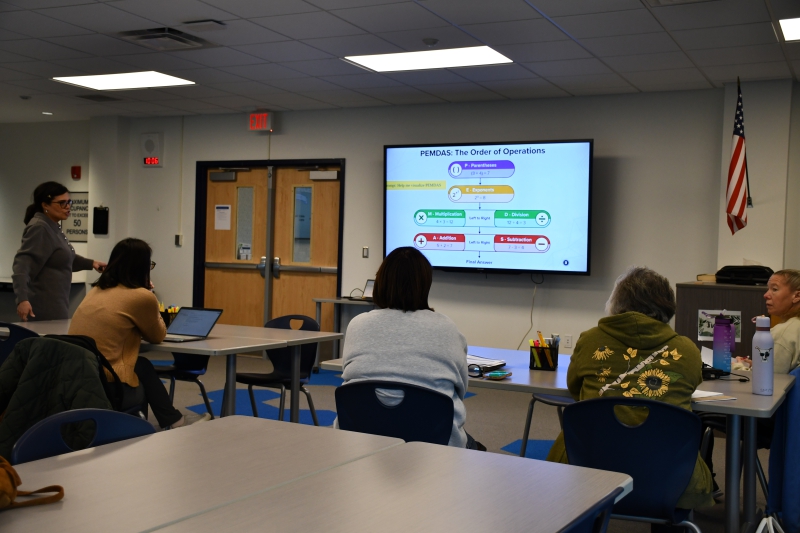
Gemini can create quizzes based on YouTube videos and PDFs uploaded to it, then translate those quizzes into multiple languages. It can also analyze handwriting via a photo or an uploaded document. Kondzielaski recommended having AI re-translate anything it translates into another language to check for clarity and accuracy. It can also take complex issues and create an illustration to make comprehension easier, such as PEMDAS, the order of mathematical operations.
Brisk Teaching can create quizzes, turn articles and videos into Google Slides and adjust reading levels for complex texts. Diffit can help adjust reading levels for classes of mixed abilities, generate reading passages for different levels and create questions for students based on those passages.
Attendees walked out with new ideas and skills for meeting students where they are and giving them the necessary support to understand material at their grade level.
CTI Special Education Teacher Heidi Thunder said, “This allows us to differentiate on multiple levels for a wide array of students in different curricula.”
Meanwhile, Nicole Cioffi, who was attending the program as part of the Education Technology department at Sullivan BOCES, was excited about the handwriting analysis in Gemini. “I’m going to give this to my OT/PT teachers at Sullivan BOCES,” she said.
The conference was well-received, with positive feedback from participants and presenters. Educational Resources looks forward to making this an annual event.